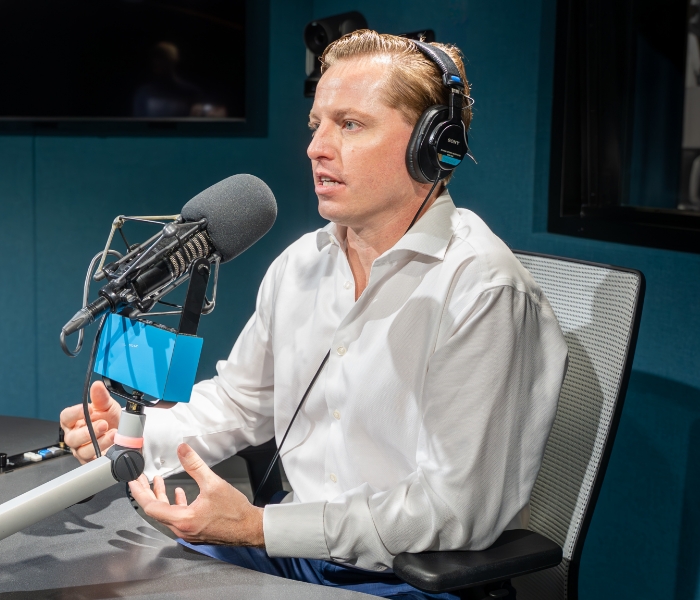
Who Is Ryan Moore, Host of Moore Money?
October 27, 2026Meet Ryan Moore: from Lake McQueeney boat builder’s son to retirement planner, and what to expect when you meet him
In short: Ryan Moore is the host of Moore Money on News Radio 1080 KRLD and president of TBS Retirement Planning in Bedford, Texas. He grew up on Lake McQueeney, where his father built boats, and skied professionally before turning to retirement planning. He focuses on retirement income, taxes and legacy planning for people roughly 55 to 80.
Click HERE to Listen to the Full Episode.
In this episode
- 0:00 Growing up on the water
- 0:43 Why 2008 changed Ryan’s path
- 2:07 The best part of the workday
- 2:48 The hidden cost of owning your own money
- 4:52 Procrastination and the math of losses
- 6:13 The RMD mistake Ryan sees most
- 6:53 Who Ryan works with
- 7:33 Will your taxes go down in retirement?
- 8:53 A Roth conversion in brief
- 12:17 What a workshop is like
- 14:20 “Why are you invested this way?”
- 16:23 What to expect at a first meeting
- 19:07 Building income, and Ryan’s take on annuities
- 21:51 Pension choices
- 23:12 Leaving money to grandchildren
- 25:14 When inheritances split families
Who is Ryan Moore?
Ryan Moore is the host of Moore Money, heard Saturdays at 4 PM on News Radio 1080 KRLD, and president of TBS Retirement Planning in Bedford. He grew up on Lake McQueeney, where his father built boats, and was a professional water skier. After seeing lake homes go up for sale in the 2008 downturn, he turned to financial planning.
What happens at a first meeting with Ryan?
It’s a discovery conversation. Ryan spends the first 15 to 20 minutes on your goals before looking at any documents. If he sees gaps between your goals and your accounts, a second meeting explains them, and a third presents possible solutions. There’s no commitment before then.
What does it really cost to own a mutual fund?
More than the expense ratio. Funds also have trading costs inside the fund and may hold cash that isn’t invested, and neither shows up in the headline ratio. If an advisor manages the funds, there’s usually an advisory fee on top. Ask for a written, all-in cost for every account.
Will my taxes go down when I retire?
Not necessarily. Ryan often sees the opposite: the mortgage is paid off and the kids have moved out, so deductions shrink, while Social Security, pensions and required minimum distributions add income. He looks at your effective rate, not just your bracket, and plans withdrawals and Roth conversions around it.
Should I take my pension as a single life, joint life or lump sum?
Each has trade-offs. A single-life payment is the highest but stops when you die. A joint-and-survivor payment is lower but continues for your spouse. A lump sum, if offered, gives flexibility for tax planning but you take on the investment and longevity risk. Once a pension payment starts, it generally can’t be changed.
How can I keep an inheritance from splitting my family?
Put it in writing, clearly. Ryan has seen siblings stop speaking over an estate. Name an executor, spell out how assets are divided, and plan ahead for things that are hard to split evenly, like land or a family home.
Next steps
Learn more about retirement income planning, get Ryan’s retirement guide, or book a free 15-minute review.
Full transcript
This transcript was edited for the web. Some statements from the broadcast were removed or clarified.
This is Moore Money with Ryan Moore powered by TBS Retirement Planning. Get more information including how to contact Ryan Moore directly in today’s show notes. Thanks for subscribing. Now, let’s get to the show. As we get rolling here with Moore Money, let’s get to know you just a little bit. Give me a little bit of your background. How’d you get into this industry? What led you into helping adults finding the retirement strategy that fits their needs? Oh, I grew up with a little bit of paradise. My dad manufactured boats for a living, so I was an avid water skier growing up. And the thing that really opened my eyes was in 2008. If you remember that economic downturn. Yeah. I literally saw more for sale signs go on to waterfront properties around my lake where I grew up than people out enjoying the water. So I realized people never really planned to fail, but some people certainly failed to plan. So in that world, I had a boat dealership previous to that and gave the boat dealership back to my father and I went into this world.
I love helping people plan and fixing problems they have in their finances. Let’s back up a little bit. Like when you were growing up, you said you spent a lot of time on the water. Was that the ultimate goal? Did you want to become a professional wakeboarder or a water skier? Did you think that’s where it was going to end up? I was a professional skier for quite a little while, but the family legacy of building boats was wonderful. Yeah. But, we got three siblings. My brother still runs the same business with my father. But I don’t know, he just went in a different field. I like helping, like teaching. Yeah. And we taught kids for a long time water skiing, but I just had the opportunity and saw the need for it. So I went into this field and I’ve never looked back. I love it. I’m about to say you’ve got into this field, you love it, but are you still considering a hobby? Getting out of the water, getting wet, or is it as you get a little bit older you realize, man, I need to stretch a little bit more if I’m going to spend the day. The falls hurt a whole lot more and it takes a lot longer to recover, I’ll tell you that.
But my body is still, or my mind thinks it can do something. My body hasn’t always agreed with it. You sound like an adult. That’s it. Exactly. You can meet Ryan and the team at retirewithmoore.com. A couple of minutes here getting to know Ryan and how he serves the community. So talk to me a little bit about TBS retirement planning. What is Ryan for you personally? What is the best part of your workday? Meeting new people is always a wonderful part. I really like being able to, I look at things from a tax perspective and I love being able to save money. Every day I can go find money that fell into the cracks and save it. It’s wonderful. Especially when we’re working with charities, much less individuals. Yeah. But that’s what really makes me motivated to come to work is seeing the bright eyes and the smiles on someone’s face. When I just saved a ton of money, they didn’t realize they were losing. You say that when you help people find that money they didn’t know they were losing. Where do you find that the most often? Is it hidden fees? Is it tax strategies?
Is it income in your world? Where do you find that? We start, I find it in all three, but we start always with the income perspective. I’m reviewing the taxes from previous year and then with knowing their finances, we can review those, we go over risk assessments and fees inside the fees or inside their accounts. People never quantify what it costs for them to own their own money and it can be exorbitantly high. And then we finally go to the estate plan side and make sure that that’s all covered and their wishes are going to be followed through. You said something interesting there. People don’t think about the expenses of owning their own money. Absolutely. Break that down for me. That’s a pretty interesting way of looking at it. I mean, if you’re going to be invested, let’s use a mutual fund, for example. A mutual fund is going to have an expense ratio, but if you go research on it, that’s all Yahoo Finance or Morningstar is going to tell you. They don’t tell you about the internal cost of it, the transaction expenses, the fact that some of the money sits in cash.
That cash isn’t growing, so that’s a cash drag. The all-in cost can be a lot more than the expense ratio you see on Yahoo Finance. And then someone manages that, so then they go charge an advisory fee on top of that. How often do you do that? You sit down with somebody for a first appointment, a first consultation, or maybe a couple of weeks in and you do that deep dive in their portfolio and the shock and the surprise from adults that say, I had no clue. I had no clue how much I was paying.
What you don’t know is what you don’t know. And it spilled milk yesterday, but you can always improve it going forward. The worst thing people can ever do is sit there and rely on things and just assume that it’s all being taken care of for them. Procrastination is one of those things as well that we as adults were guilty of procrastination, be it yard work, be it, I’m going to get back to the gym or I’m going to get better at my golf game.
But we as adults, what are we saying? I’m sure you’ve heard this too, Ryan of people saying, hey, let me get through the election and then I’m going to call and get serious about my tax strategy. All right. Well, let me just let me get through the first of the year. Let me get to the first quarter. Okay. [unclear] Summertime is here. I got a couple of vacation. Okay, seriously at the end of summer. All right, crap. Okay. Fall is here. And then you’re back into that vicious cycle. Procrastination can do so much damage to an overall portfolio, Ryan. Absolutely. It just takes one little bit of a loss. You know, if you lose 50% today, which is not a little loss, but for easy math, you got to have 100% return just to break even again. And then if you’re living on that amount of money, you’re sucking out of it. There’s a good chance it’s going to fail. Ryan, we talked about what you enjoy about serving the community. I’m pretty sure you just hit on it just a little bit, but what’s the biggest challenge you find with customizing retirement strategies?
Oh, that’s got to be the assumptions that people make, whether it’s based on myths or misconceptions or just incomplete facts in the first place. People become biased and brainwashed a lot. Yeah. And it’s really just about educating them on the tools they’re using and tools that are available to it. What’s the biggest misconception that you see from adults? That might be. This may be a long-form conversation, but just right off the top of your head, what do you see the most? You know, the single biggest thing that I see frequently, and I’ve never thought I would, is that people will pull out of their retirement accounts for RMDs because they’re required to pull them out and then they’ll go reinvest them right back into their same retirement account, which they’re going to pay taxes on that money twice then. It’s insane to me, but I mean, it can be a common misconception because you’re forced to pull it out, but they think it’s qualified money, so they just put it right back in.
Ryan, who needs you the most right now? If you could describe the adult that really needs your help that you want to call so you can help them put a plan together, who would that be? Oh, I mean, I help people from, I’d say 55 to 80 years old or so with either retirement planning or legacy planning there. I like to sit down while you’re just before you’re about to retire so you have time to make changes in education. Anyone that is sitting around you, there’s always something you can typically improve, whether it just be a little bit of tax planning, longevity, covering long-term care costs or those fears. Income planning, income planning is huge. Yeah. So many people don’t have an actual written income plan and that can make a night and day difference in someone’s life. Right. We’re talking about some of the big misconceptions in retirement planning. So I think one of them is, and correct me if I’m wrong, I know you do a lot of work with tax strategies.
How often do you find that adults think that once I retire, Uncle Sam, he’s going to retire with me? That was the age-old conception, that you’re going to save all this money up and be a lower tax bracket when you retire. Yeah. But people never thought you realized that they like their lifestyle and want to maintain that. That normally costs money. So how do you help them? Tell me about some of the tax strategies that are working in the community and kind of some of the education that you teach adults. It’s really just going over the effective tax rate. A lot of people think that they’re going to jump into a new quote-unquote tax bracket. It’s going to, that’s what they’re going to pay to do a conversion. Yeah. You know, 22 or 24 percent, but that’s not the case because all the other brackets below that are much less. You know, when you’re working, you’ve got a mortgage payment. You’ve got kids at the house. You’ve got all these write-offs. And then unfortunately, when you retire, now the mortgage has probably been paid off. The kids have moved away.
You don’t have any expenses anymore. So you’re just on the standard write-off now. That can jump into a higher tax bracket. If you don’t do any proper planning, Social Security kicks in. You’re going to have to double taxation on that. The amount of conversions you can do in the Roth can be wonderful. You can use municipal bonds in some part, but that also applies against your Social Security income. And you can use life insurance. Those are three legal tools that can provide tax-free income when they’re used under the tax rules. People don’t take advantage of this as much as they should, unfortunately. You just mentioned a Roth conversion right there. So somebody could be listening this weekend just getting serious about their retirement strategies. They’ve heard Roth before. They’ve heard that, why don’t I want to, I don’t know if I want to pay all the tax up front. That could get a little costly, but there are benefits behind it. So I guess, Ryan, give me a Cliff Notes version of the benefits of a Roth conversion right now. The main downside of a Roth conversion is the taxes you’re going to pay on it.
But if you think taxes can go up in the future in this country, and you know right now what you’re paying effectively, chances are that’s going to be higher into the future. So why not take advantage of it? Even if you don’t need the money, if you plan on giving the money to your heirs, they can generally receive it income tax-free, though most heirs have to empty an inherited Roth within 10 years. You don’t have RMD requirements on a Roth. Unless the tax rate is so high you’re not going to make back that money, it’s worth looking at whether a conversion makes sense every year. But CPAs, tax people, they all sit down in March, April, May to go do their taxes, hopefully not longer than that, but you can’t do any conversion and it has to be done in the calendar year. So we pretty much dedicate the third quarter of our office primarily just to tax planning strategies. So then people have the time and the know-how to see how the year went for them, any expenses that arise, surprise them, and they have time to make changes if they need to.
So when it comes to a Roth conversion, is there a specific time of the year that it’s best? Is it something you should do at the end of the year, the first of the year, or any time of the year as long as you’re getting educated about it? I like doing them around September, October timeframe. Then you, again, know how the year went and you have time to make changes. Before COVID, it took maybe seven days to move money around and we’ll call some of the largest companies on the planet and it’ll take 14 days and you still see dogs in the background of people. So I like having that extra cushion time. And when it comes to a Roth, and correct me if I’m wrong, it’s like the difference between getting a spanking and getting grounded, because a spanking, you take the pain up front, but then the trouble is over. That’s like a Roth because you pay the taxes up front or you could get grounded.
All right, it’s less painful, but it lasts longer wherein you pay the taxes over time. Is that fair? Yeah, but I mean, you’re going to have compound interest, which is quote unquote the eighth wonder of the world. And would you rather be taxable compound interest or tax-free compound interest? There is a five-year window on each time you do a conversion, but five years is kind of a blink of an eye for most people. Right, yeah, totally agree. Because we’re always thinking about taxes. I know a lot of our conversations are going to be based around your tax strategies. You know, a lot of adults, they think, okay, April’s behind me, I’ll file my taxes. I’m good to go until the end of the year. That is a very dangerous way of thinking regarding taxes, Ryan. Absolutely. No one, I shouldn’t say this on the air, but I mean, no one enjoys paying taxes, but it is what builds our community and our beautiful roads and everything you get to enjoy in America today.
But Judge Learned Hand said, there’s nothing sinister and arranging your affairs to pay less to the Treasury. You don’t even have a patriotic duty to do so. Yeah. But you have to know the tax codes to be able to apply them to your knowledge. Use as many write-offs as you can that are legal. That’s what they’re there for, but what you don’t know is what you don’t know. I heard somebody made a good point and they were like, look, it’s a privilege to pay taxes to live in this country. It’s painful, but it’s a privilege. I’ve never heard anyone say the word is privilege, but yes. Retirewithmore.com, retirewithmoore, retirewithmoore.com to meet Ryan and the team, see all the services they have to offer and get information. You’re always doing seminars and workshops and great events across the community. So walk me through if I’ve never experienced one. What does it look like when I walk in? What can I expect? How do those work? I mean, we do educational events.
We do dinner presentations, but on a dinner presentation, I’m going to invite you to dinner, and it’s going to be an amazing dinner coming out. I’m going to sit down and go over the key problems that I see with everyone that comes to my office and strictly educate them. I’m going to go over the things that I see every day and help educate the people in the room. And then if they want to come into the office to see if we can help them, we’ll schedule an appointment. It’s strictly discovering to get down and see what the concerns are. Speaking of concerns, what seemed to be the biggest concerns of adults in the community and the families you serve? Well, this year’s market volatility, but outside of that, a lot of people see a light at the end of the tunnel, so to speak, and they’re not motivating themselves to change, and they’re keeping that same old path.
[A segment unrelated to financial planning has been removed.]
So do the families you serve, do they get worried about the news or do they feel confident in their plans that, hey, I’m just going to sit back and watch and see what happens. I’m feeling good. The biggest thing that I ask everybody whenever they come to my office, after we’re getting over who they are as a person, what they want to achieve with their monies, well, I’ll do a review of it, but I’m going to ask them the simplest question ever and I always get the same answer. It’s sad, but I’ll ask them why they’re positioned the way they are. And they might be a very conservative person, very salt of the earth, and they have a super high aggressive portfolio, and I’ll ask them why, and the worst thing that I always get told is, I don’t know, that’s just the way my advisor has me.
I want people to know what their money is. It’s their money. Yeah. I mean, they’re going to know their own soul better than anyone else. So take control of it. When we give investment advice, we act as fiduciaries; insurance is a separate relationship. Either way, challenge your advisor and make sure that it’s in your best interest all the time. That should always be the number one question you ask when working with… Come on, I could be listening this weekend. They’ve been working with a big box firm to feel like their needs aren’t being met, and they hear you, Ryan, and they just heard the F word right there, and that was such an important word in retirement planning. You know, fiduciary is also based on where they work. If you have someone that’s only going to be like a product [unclear], a product focus advisor, maybe they only sell mutual funds, or they only sell gold, or they only sell insurance. If you go into their office, what are they going to talk about? The only thing they can offer you.
So they’re going to give you biased information about other things, not because they aren’t trying to do the best of their abilities, just because they’re a one-trick pony, and that’s all they can offer you. I’ve met some great advisors from big box names, and even the single product focus type advisors, but if you wanted to go buy a Ford, and you went to a Toyota dealership, what are you going to walk out with? It’s not because one vehicle is better than the other, it’s just because that’s all they can offer you. So make the phone call, set up the appointment, walk through the front door, break it down for me, paint the picture. I’m a little bit nervous. What can I expect? You’re going to walk in the door and be greeted with a smile on your face. The first thing we’ll offer you is a beverage or a snack to kind of just make sure everything’s good to go there. I may or may not have my wonderful border collie. She might greet you. She comes to the office quite frequently. There’s no purpose of coming in there and having any apprehensions. It’s just a discovery meeting.
Leave your checkbooks at home. We’re just going to sit down and talk to you, but I’m going to spend the first 15, 20 minutes without looking at a single document. I’m just going to find out who you are as a person and what you want to do in life, what you want to achieve. Do you look for income streams now? Do you have plenty of money? Are you concerned about giving money to your kids? Do you not like your kids? You want to give it to the grandkids? I want to know about your goals and what you want to achieve and then we’ll start looking at documentation. But if what you tell me is not what I see in those documents, I’m going to say, hey, I see some discrepancies here. Let’s schedule another meeting and then I’ll go over and educate you why I saw those. And if at that point in time you see what I saw and you think it’s a problem, we’ll schedule a third meeting and then we’ll have a plan or a possible solution for those problems.
There’s no commitments whatsoever up until that third meeting. If you see value in my plan, I’m just going to say, hey, please implement that with a firm. Don’t take it right to your old advisor because I shouldn’t have been able to find those concerns or problems in the first place. Right. So if you take it right back to them, it’s probably going to fail again. Is it fair to say it’s, Ryan, almost like a first date. You’re both a little bit nervous. You get to know each other a little bit. Replace them wine and bourbon with maybe a nice cup of coffee. Just get to know each other. I was raised with good etiquette. I’m going to open up the door first for you on your first date. But you might have meet me by the front door a little faster if I’m sitting in the office. So that’s just the opportunity to get to know each other. And again, you’re not required to become a client. And I’ve heard Ryan say before, there have been some situations where he looks at someone and says, look, man, there’s nothing I can do for you right now.
Call me back in the future. Or maybe go implement this and let’s stay in touch. [unclear] It’s probably the best badge you could ever get. If I wouldn’t change a thing, you’re doing great. Yeah. Just level of confidence there is wonderful. How often do you work with somebody? You take a deep dive into their portfolio and they come in there terrified. We’ve all made financial mistakes, Ryan. Everybody has made a mistake in their past. They come into you a little bit nervous and they just want to know, Ryan, where am I? And you get to say, you’re doing much better than you think. That is a wonderful thing. You know, sometimes I put on a quote unquote janitorial hat and helped try to fix those mistakes and clean them up. Yeah. People are amazed that it doesn’t take as much money to have a quality of life that they live as they think it does. But it does take consistent good returns to make that achieve. But you start adding in pension income and social security income and annuity income and things like that, then those are going to be there for your entire life.
And then the income gap, if you have one, they’re pretty easy to find. There’s amazing tax codes. There’s great vehicles. There’s investment strategies that all help people. You mentioned that about people coming in and sit down with you and they learn more about themselves. They learn more about their portfolio. And we all have these fears, if you will. We always worry about income because income is the outcome that matters the most in retirement. So how do you help build income in retirement, Ryan? Most people say dividends is always the answer there. I very rarely see a dividend portfolio where the value of the equity doesn’t go down as the dividends are coming out. So I’m going to look towards more guaranteed sources of income first for the must-need amount of money. If you need $100,000 or $150,000 a year, I don’t want it to be a gamble for you because that’ll ruin a portfolio very quick on a bad year.
Some people love annuities because you always hear it’s the opportunity for guaranteed income that lasts as long as you do, backed by the insurance company’s claims-paying ability. And some people say the annuities aren’t worth the paper that they’re written on. Ryan Moore, where do you fall about the annuity conversation? I don’t have a single problem with annuities. I actually like them. They can fit quite a bit of a value for certain people. But you got to make sure you have the right annuity, the right type of annuity for the right purpose. I mean, anyone with a pension technically has an annuity. That’s what they are. But there’s four different kinds. You got SPIAs or single premium immediate annuities like pensions. You have fixed rate annuities, where there’s just a guaranteed rate of return for X number of years, backed by the insurance company’s claims-paying ability. You got fixed index, where you can have a little bit higher possible growth capacity or link to the market, but you’re not directly in the market, and you have protection from market losses, backed by the insurance company’s claims-paying ability.
And you have variable annuities, which was Wall Street’s way of trying to get in the insurance world. So for more information about an annuity, well, let me ask you this, before I get to that, why is it? Why do people, because there are some financial advisors out there, they will say, don’t even come to me asking about an annuity because I’m not even going to have this conversation with you. Why is there that negative connotation? Some firms won’t offer commissionable products at all. Annuities aren’t a one-solve, fix-all, but they can be a great thing for many people.
But again, you gotta place the right one. Though, if I talk about income right now, you work for 35 years for a company, you get a pension, and they’ll give you an income stream for your life or a joint life. And then you gotta think about the odds of that. If you take a single life, you’ll get the highest amount from the company, but you die the next day, your family gets nothing. You take a joint life and the spouse passes away, you live on less for the rest of your life. If you wanna do any tax planning, if the company offers you a lump sum, you can do tax planning with that money throughout your entire life. A lot of people don’t realize, or maybe when you educate them, you say, listen, everybody wants and wishes they had a pension, but the reality is, an annuity, social security.
Those are pensions, Ryan. Pretty much. And in the Dallas area here, we’re more fortunate than a lot of the other areas of the country, and there’s still a ton of pensions out here, but when you do turn on a pension, it is set in stone, and I don’t like things that are set in stone. I like a little bit of flexibility so I can improve, do tax planning, and make it better across time. Yeah, so if you have a pension right now, and maybe you’re just curious, are you getting all the benefits that are available? We invite you to call Ryan Moore and the team at TBS Retirement Planning. That number is 972-433-7488. Again, 972-433-7488 to have a deeper conversation about pensions, about annuities, but most importantly, about building income in retirement. You mentioned a couple of minutes ago about the grandparents wanting to pass down the money to the kids and the grandkids.
Did you hear that’s a current trend right now? A lot of boomers. Instead of giving money to their kids, they realize that the next generation are so financially uneducated that boomers are now skipping their own kids and leaving inheritances to the grandkids because they’re worried about them. Is this a real trend, Ryan? You’re seeing this? Absolutely. I see it all the time. Before the SECURE Act came out, I used to write multi-generational wealth plans with my eyes closed, but now a lot of those plans have been eradicated by the 10-year rule. So the money has to be taxed and you’ll spread it out across your grandkids. Most people did a great job in their career. They did a great job as parents and raised children even better than they were. And those children are in their peak earning years and they’re making a great living.
But real estate’s skyrocketing, all these costs of living inflation. So it will take way more money for the grandkids to live the quality of life that their parents or their grandparents did than they might be able to achieve. So giving that little extra boost and legacy. And it also just keeps your name alive across generations. You’ve heard that before with the phrase silver tsunami because what over the next seven, eight, 10 years, trillions and trillions of dollars will be passed down from the boomers down to the next couple of generations. So if somebody’s listening this weekend, they’re like, yeah, I plan on passing it an inheritance down. What would you tell them so that they wanna leave their kids, their grandkids, some money, but they wanna do it in the most tax efficient way possible. There you go. Yeah. What are some of the tips you offer? Life insurance can be a useful wealth transfer tool.
It’s literally a self-completing contract. But using tax planning, using structures, making sure that your estate plan is not gonna cause a tax liability when you’re no longer there and just make sure everything is written properly for you because the day that they pass away, they’re no longer there to say, hey, this is what I really meant. I just didn’t word it properly. Yeah. And I’m sure you’ve seen some, I almost cussed right there. I’m sure you’ve seen some crap when it comes to legacy planning about families that maybe a form wasn’t filled out right, not by your doing, but just somebody comes in and says, hey, my dad passed away and here’s this information, forgot to sign this, the ex-wife’s name’s on this. The kids didn’t get this and it just turns into a nightmare.
So writing things down properly will keep the family whole even though blood’s supposed to be thicker than water and families, but money can be a greedy thing and change a lot of people. You know, not to get too personal with you. I saw the exact same thing happen when my dad passed away. He had a little piece, a little tiny piece of property about in the mountains. And I mean, not the postage stamp size piece of property. It wasn’t properly allocated on the legacy plan. I think he probably forgot about it. Man, the infighting between my aunts, his sisters, these aunts that I love, that are family, that are blood to see them argue over a couple of trees in a hill. Like you’ve got to be kidding me. And it just, it really kind of drove a dagger and made a bad situation even worse. And that’s why the importance of a prior planning there, Ryan. There’s a lot of land in Texas, right?
We’re a huge state. And, grandpa might pass away and leave a couple of hundred thousand acres, whatever it might be. And you’re going to go split that three ways down the side. But line A over here has a lake on it. Line B is just a bunch of rocks. And so what’s the equal value there? Do you have the option of one kid go buys it out or the other? Maybe doesn’t have the money. Maybe the other person don’t need it. Yeah, legacy planning is a wonderful, wonderful thing to give security and those kinds of things to make sure that that land stays in the family for generations. Yep. Ryan Moore, full service firm. We’re talking about building income and retirement, the importance of a tax strategy, but also the legacy, not just for you, but your family as well. These are the conversations that you will have. 972-433-7488. By contacting us, you may be provided with information about insurance products, including annuities offered through Ryan Moore, Texas insurance license.
Annuity guarantees rely on the financial strength and claims-paying ability of the issuing insurance company. Read your contract for restrictions, limitations, or penalties. Neither the firm nor its agents or representatives may give tax or legal advice. Individuals should consult with a qualified professional for guidance before making any purchasing decisions. Ryan Moore is not affiliated with or endorsed by the US government or any governmental agency.
Moore Money with Ryan Moore is for educational purposes only and is not investment, tax or legal advice. Investment advisory services are offered through Brookstone Wealth Advisors, LLC. Insurance and annuity products are offered separately through licensed agents. Guarantees are backed by the financial strength and claims-paying ability of the issuing insurance company.